The bigyellowfish platform was built on the premise that, if 80% of maritime incidents are linked to human factors, then human reliability is not just a crew welfare line item — rather, it is the most under-invested risk management capability in maritime enterprise.
Fatigue, cognitive overload, suppressed near-misses, fractured communication, and isolated crew are not ‘welfare issues’. They are the upstream causes of incidents appearing on your claims register. The question is whether your enterprise has the tools to see this layer before it cascades into loss…
The gap shows up in familiar places. It shows up in bridge watchkeeping failures rooted in undetected cognitive fatigue and situational overload, and in cargo and mooring errors driven by time pressure and ambiguous task communication. It shows up in near-misses suppressed by psychological unsafety — because crew that do not feel heard do not report. It shows up in crew mental health crises that stay invisible to management until a MEDEVAC event or an early repatriation forces them into view.
And it shows up quietly, in the places that never make a report at all: safety communications absorbed by noise, where reach does not equal impact; and a culture that exists in policy documents but not in the lived experience of crew across rank and nationality. Each of these is an upstream cause, and each of them is observable long before it becomes a claim.
The Pressing Leadership Question
Can you see the human risk layer in your operation right now?
Not their certification. Not their hours-of-rest log. Their actual state — the cognitive load they are carrying, whether the safety broadcast received this morning was read and understood, and whether the collective sentiment across your fleet is moving toward risk or resilience.
- 01Do you have real-time data — or even ‘just in time’ data during crucial events, when your human capital is most susceptible to human error — on crew wellbeing trends across vessels, ranks and nationalities?
- 02Can shore management send targeted, contextual safety communications to the right crew at the right moment?
- 03Do you know which vessels carry high unresolved cognitive load, with crew under pressure and no outlet?
- 04Is your frontline visible and audible, such that crew feel they have a voice that reaches leadership?
- 05And are your wellbeing, communication and culture initiatives integrated, or are they still isolated, siloed tools?
bigyellowfish is the only platform purpose-built for the maritime frontline, designed for human reliability. For more than five years now, we have observed, understood and monitored critical data points that throw light on the WHY, the WHERE and the HOW behind this underserved risk management opportunity, through the lens of HUMAN RELIABILITY and long-term SUSTAINABILITY. With the launch of this KNOWLEDGE SERIES, we shall unveil some of the most pressing observations made on our platform, with the aim of democratizing our learnings and helping drive a meaningful impact in the industry. Here’s a quick introduction to the BYF Canvas in this month’s article.
The BYF Canvas
Every figure that follows is drawn from continuous platform observation — behavioural evidence gathered in the flow of work at sea, across five years and 92,074 seafarers. In the most recent quarter (AMJ 2026), 71,818 of them — 78 in every hundred — were active on the platform, dense enough coverage to make what follows a reading of the workforce, not a projection from a sample. This is the population we observe. This is what we found.


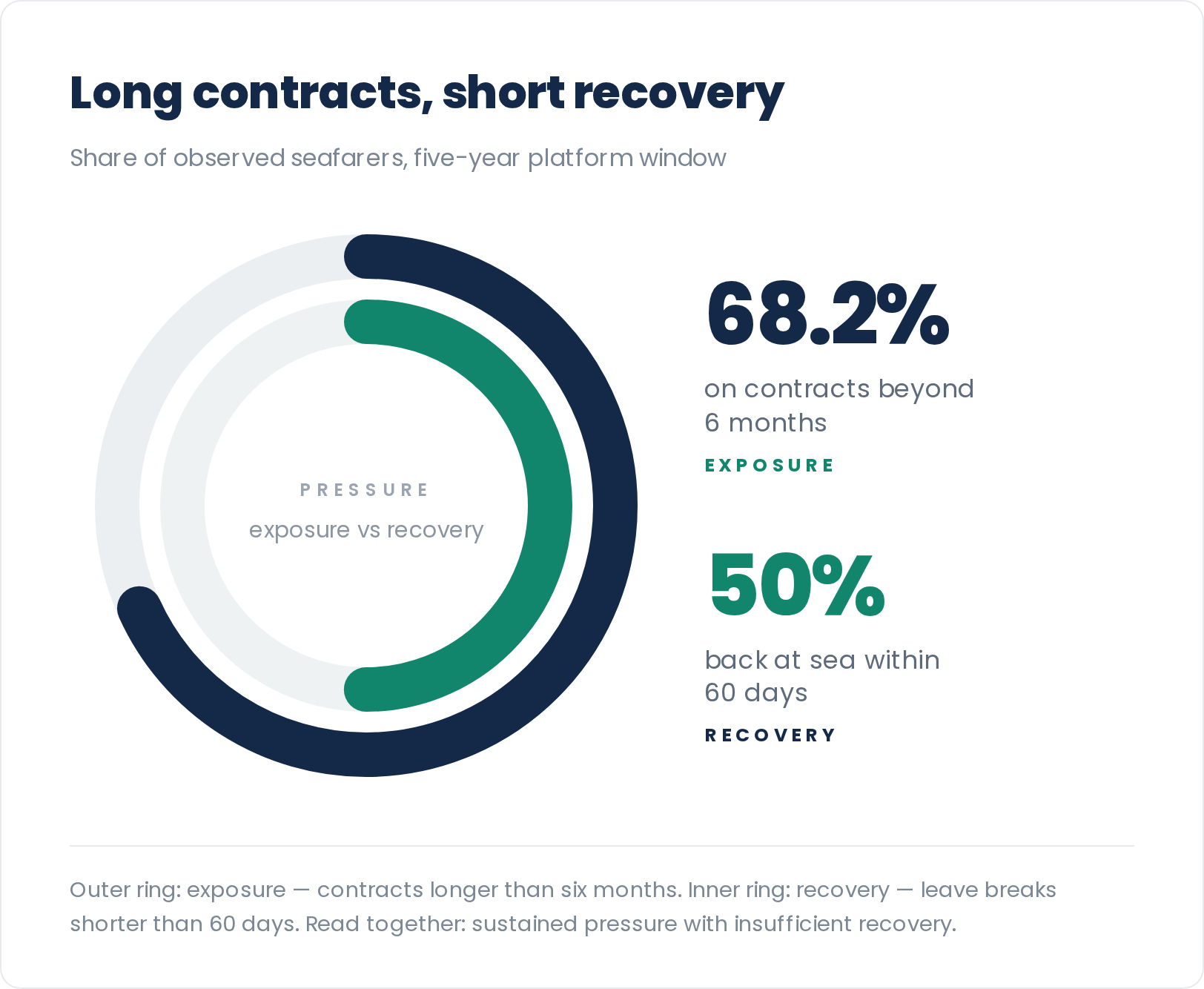

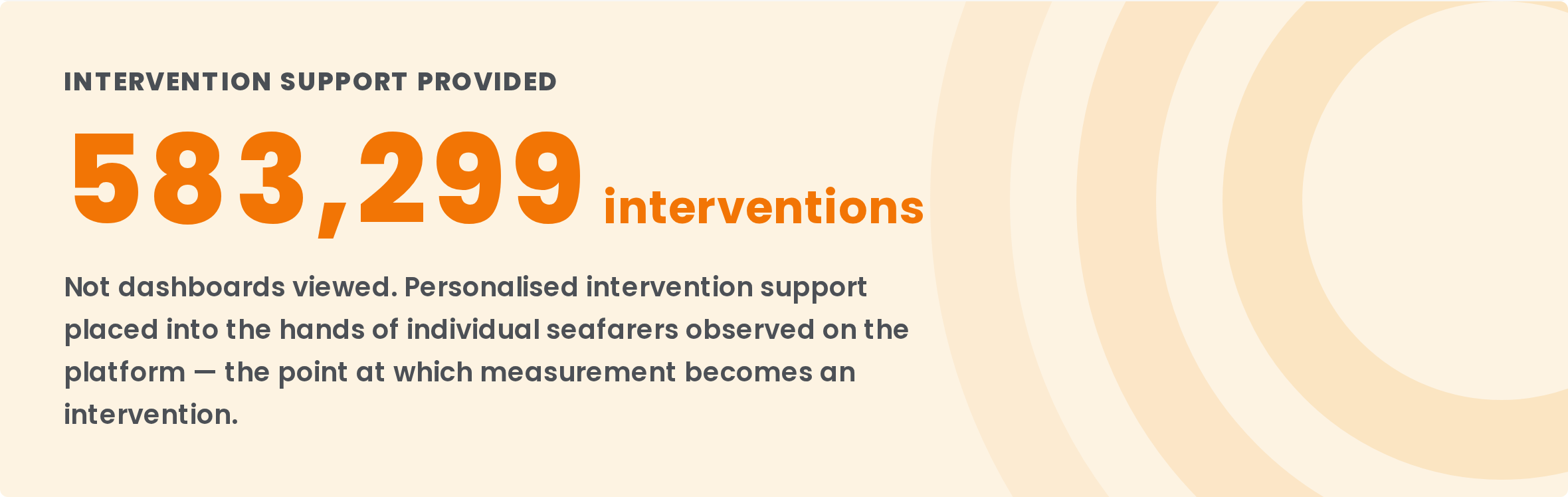
We will let these numbers sink in. Each one is a signal. Together they tell a story the industry has not had the tools to read — until now.
The Burnout Index — the underlying story, and how the platform assists with on-time leadership action items.
bigyellowfish is purpose-built for the maritime frontline. Its three pillars — Holistic Health & Wellbeing, Communication, and Social — are not separate wellness tools. They are a unified human reliability platform, engineered in behavioural science, gamified for sustained engagement, and designed to generate auditable evidence for leadership and insurers.
The insights and findings in this Knowledge Series are based on empirical data available on BigYellowFish (“BYF”) platform available to BYF at the time of publication. They are generic and informative in nature, they should not be interpreted as representative of the entire maritime industry or as a prediction, or determination of any individual or organisation.
The metrics, indices, methodologies, and observations may evolve as additional data becomes available. Unless expressly stated otherwise, all statistics and observations should be read in the context of the relevant methodology, population and period. The information is not a substitute for professional advice, and readers should undertake their own assessment before relying on it. Nothing in this publication or any engagement with BYF creates a therapeutic or advisory relationship. Any extrapolation beyond such context is undertaken at the reader’s discretion and risk and BYF shall not be liable in any manner whatsoever.
Leave a Reply