Burnout is more than everyday tiredness. The World Health Organization classifies it as an occupational phenomenon resulting from chronic workplace stress that has not been successfully managed, marked by three signatures: emotional exhaustion, growing cynicism or detachment from one’s work, and a declining sense of personal effectiveness.
In most desk-based industries, burnout shows up as disengagement, absenteeism, or attrition — costly, but rarely life-threatening. In safety-critical industries, however, burnout takes on a sharper edge. Here, a worker’s cognitive state is directly wired into physical outcomes: a lapse in vigilance, a delayed decision, or a missed check can translate instantly into an accident, injury, or catastrophic failure.
Maritime shipping is arguably one of the most concentrated environments for burnout risk in the world. Several structural factors converge on board a vessel that rarely coexist elsewhere. How does one track these multidimensional factors, and is there a system that can narrow its gaze and come closer to building such a probability metric? Firstly, is it even important, and can it impact risk management?
The link between this strain and operational risk is not speculative — it shows up consistently in incident data. In an industry where a single grounding, collision, or spill can cost tens of millions of dollars in vessel damage, environmental liability, cargo loss, and reputational harm, even a conservative reading of these numbers makes burnout a material line item in operational risk, not merely a wellbeing footnote.
“Even a conservative reading of these numbers makes burnout a material line item in operational risk — not merely a wellbeing footnote.”
This is precisely why burnout deserves the same treatment as any other leading indicator of operational risk — measured, tracked, and acted upon before it converts into an incident. Most safety management systems are excellent at capturing lagging indicators: near-miss reports, injury rates, non-conformities after the fact. Far fewer capture the leading psychological, physiological and organisational indicators that predict when a crew, a watch, or an individual officer is entering a high-risk state. A structured burnout-probability metric becomes inevitable. This shifts the organisation from reactive incident response to preemptive risk management: a data-driven decision rather than a response made only after something has already gone wrong.
In a safety-critical industry, investing in the health and wellbeing of the people at the controls is not a soft cost. It is one of the most direct and measurable ways to protect the assets, cargo, environment, and lives that operations depend on.
The BYF Canvas
Here is what our platform has observed regarding burnout, and the Burnout Index we built from it. A system that activates a baseline burnout index at the get-go and then infuses several adjacent factors, into the flow of work, to empower organisations with the tools to take timely actions, when they matter the most.
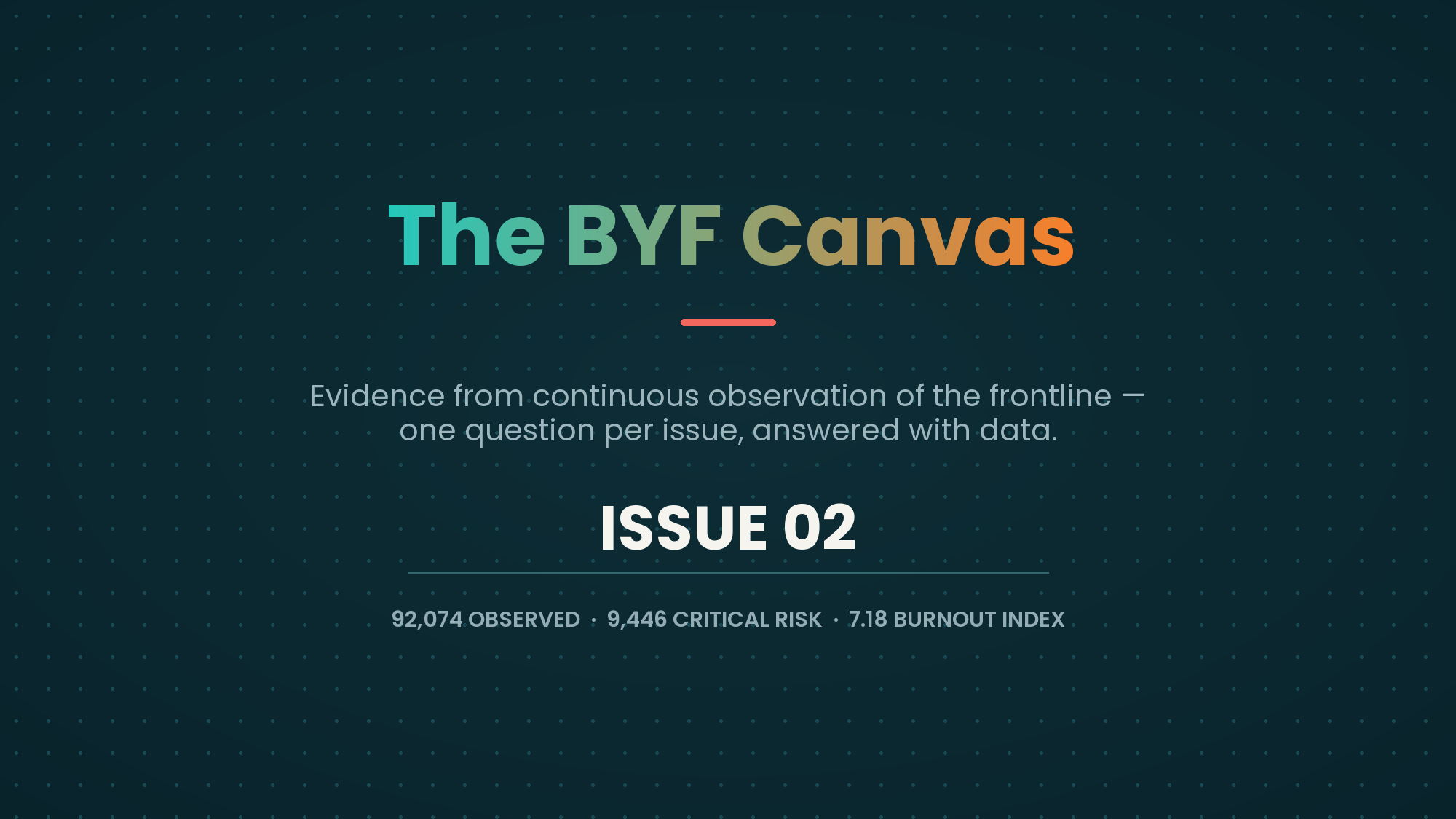
Every figure that follows is drawn from continuous platform observation — behavioural evidence gathered in the flow of work at sea, across 92,074 seafarers.


These are just the key metrics that could form a deeper baseline understanding of the prevailing burnout in the industry. Imagine having this understanding at all times, and a system that triggers alerts with recommendations when you need it the most?
The psychological dimensions that impact performance, and the observations from the bigyellowfish platform.
bigyellowfish is purpose-built for the maritime frontline. Its three pillars — Holistic Health & Wellbeing, Communication, and Social — are not separate wellness tools. They are a unified human reliability platform, engineered in behavioural science, gamified for sustained engagement, and designed to generate auditable evidence for leadership and insurers.
The insights and findings in this Knowledge Series are based on empirical data available on BigYellowFish (“BYF”) platform available to BYF at the time of publication. They are generic and informative in nature, they should not be interpreted as representative of the entire maritime industry or as a prediction, or determination of any individual or organisation.
The metrics, indices, methodologies, and observations may evolve as additional data becomes available. Unless expressly stated otherwise, all statistics and observations should be read in the context of the relevant methodology, population and period. The information is not a substitute for professional advice, and readers should undertake their own assessment before relying on it. Nothing in this publication or any engagement with BYF creates a therapeutic or advisory relationship. Any extrapolation beyond such context is undertaken at the reader’s discretion and risk and BYF shall not be liable in any manner whatsoever.
Leave a Reply