“Hello… How are you feeling today?”
A simple question. A common conversation starter. A formal and polite way to check in with colleagues every day. We usually don’t expect answers beyond “fine” or “great” … maybe a little chatter about how the weather has been lately. But anything beyond “feeling fine” is usually not in our syllabus.
But how do we answer this question when navigating crisis and geopolitical unrest globally? A simple question may then become extremely heavy to answer on some days. Given the current state of affairs, how are we really feeling today?
When the burner at our house stove leaks and a fire breaks out… how are we feeling? When a thief breaks into our house and robs us of everything…
how does one feel? Do we even have the time to “feel” in those moments?
And what happens after?
The night after the house is robbed. After the police complaint is lodged.
Is it peaceful? Or is it somehow even scarier? The fear that it might happen again. Double-checking the locks. Every whisper, every footstep — the body is in fight mode. The anticipation of threat is high.
How does one feel then? How is one supposed to feel in a crisis?
Before we answer that, let us ask:
What is a crisis?
“Crisis can be defined as any sudden, unstable, and unexpected event that disrupts normal functioning — for individuals, communities, or organizations.” This could include emergencies, accidents, organizational failures, or deeply personal losses.
Beyond the obvious physical impact one may endure, even witnessing a crisis, hearing about it, or expecting to be in proximity to it can have a deep impact on our psyche and overall wellbeing.
What is the psychological impact of a crisis?
While this cannot be neatly wrapped in a single article… broadly speaking, our brain enters the ‘fight or flight response’ when navigating threat or perceived threat. This means our nervous system gets dysregulated in order to protect us. So, intense fear, anxiety, confusion, and helplessness are some of the few ways crisis can impact us, psychologically. It can make it difficult to think clearly or process information.
While for many, this distress reduces over time, for some, it may linger long after the crisis ends, till the body feels safe again.
So… let us ask again. How is one supposed to feel in a crisis?
Fear? Stress? Anxiety? Panic? Anger? Disappointment? Grief?
There is clearly no one “right way” to feel. On some days, we may feel contrasting emotions — anger because it’s not our fault, yet we are facing the consequences. Fear because it is not in our control, yet it impacts us. Worry for loved ones. Disappointment in the present circumstances.
At times, there may be exhaustion, numbness, or a need to withdraw. Because it can feel like too much — constant updates, uncertainty, instability. This is not unusual in crisis. You may find yourself thinking, “Why am I no longer caring?” and feel numb — and then, a few hours later, something triggers panic again. The outside instability can make the inner world feel restless, like a roller coaster.
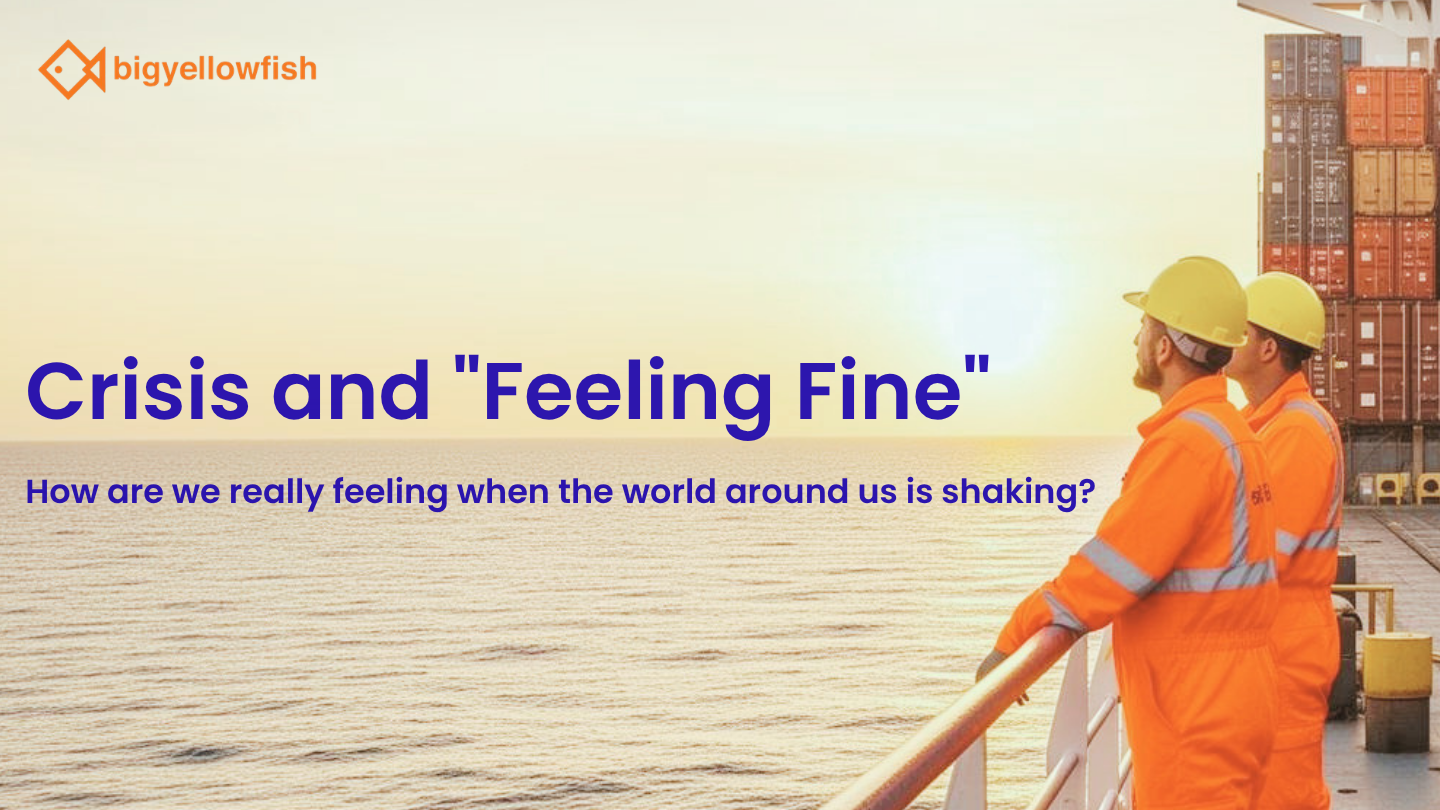
When we think of seafarers, we often associate them with resilience, discipline, adaptability, and strength. But what we sometimes forget is that these are built over time through training and experience.
Crisis, however, is sudden. It leaves little time to prepare and can shake anyone and everyone. Feeling fear, anxiety, worry, or loss in such moments is not the opposite of resilience — it is a reflection of being human.
Does that mean crisis is only about worrying?
While much may be outside our control, we still have some inner anchors that can help us navigate these moments — even if just a little more steadily.
Ask yourself: when my mind is spiraling, who do I share it with? Do I release what I’m feeling, or do I hold it in? Has bottling it up really helped so far?
Reaching out to a mental health professional may not change what is happening outside, but it can help you feel more grounded within.
And sometimes, the most immediate support is right next to you.
Talking to a crew mate. Sharing a moment. Saying, “I’m not fine today.
I feel afraid, and angry, and confused.”
Because the person who best understands your fear in that moment may be the one experiencing something similar.
When you feel understood, the sense of belonging in uncertain times can act as a balm. Crisis definitely disrupts our sense of safety — but human connection is one of the strongest ways to rebuild security and wellbeing, one moment at a time.
So maybe we continue to ask each other, “How are you feeling today?”
— but this time, with the willingness to hear something more honest than just “fine.”
Leave a Reply