For decades, organizations in safety-critical industries have measured human performance through a particular lens — lagging safety statistics, compliance audits, and training completion rates. These metrics answer “did something go wrong” long after the conditions for failure were already in place. But, what if, performance, safety, and wellbeing are not separate outcomes to be measured in isolation, but the visible results of an underlying human system that can be understood, tracked, and strengthened in advance.
The bigyellowfish's HPI does this by assessing three interconnected capacities — Psychosocial Security, Worker Health & Safety, and Organisation Culture and infuses the Job Demands & Resources model to deliver a holistic view that covers psychological, physiological & organisational factors that impact performance at the workplace — treating them not as HR checkboxes but as the operating conditions that determine whether a workforce can perform reliably under pressure, day after day.
What distinguishes the HPI further is its grounding in the Job Demands-Resources (JD-R) model, a well-established occupational psychology framework that explains workforce strain and engagement as the outcome of a balance — or imbalance — between what a job demands of a worker and the resources available to meet those demands. This is the mechanism that connects the three broad capacities to something an operations leader can actually act on: not a generic wellbeing score, but a specific signal that, say, workload demands on a night shift are outpacing the recovery resources available to that crew, with a quantifiable effect on expected performance and safety behavior.
This combination — breadth of capacity plus industry-specific precision — is what elevates the HPI into an operational risk and performance instrument. When psychosocial security, health and safety load, and cultural health are tracked together and benchmarked against the demand-resource realities of a specific industry, leadership gains a leading indicator that behaves much like a vital sign: visible before a crisis, not only diagnosed after one.
Ultimately, the case for an index like the HPI is the same case that underlies modern operational risk management everywhere: what gets measured gets managed, and what gets managed early gets managed economically. Organizations in safety-critical industries already accept that equipment requires continuous condition monitoring rather than run-to-failure maintenance; the same logic applies to their human systems.
The BYF Canvas
Here is what our platform has observed:
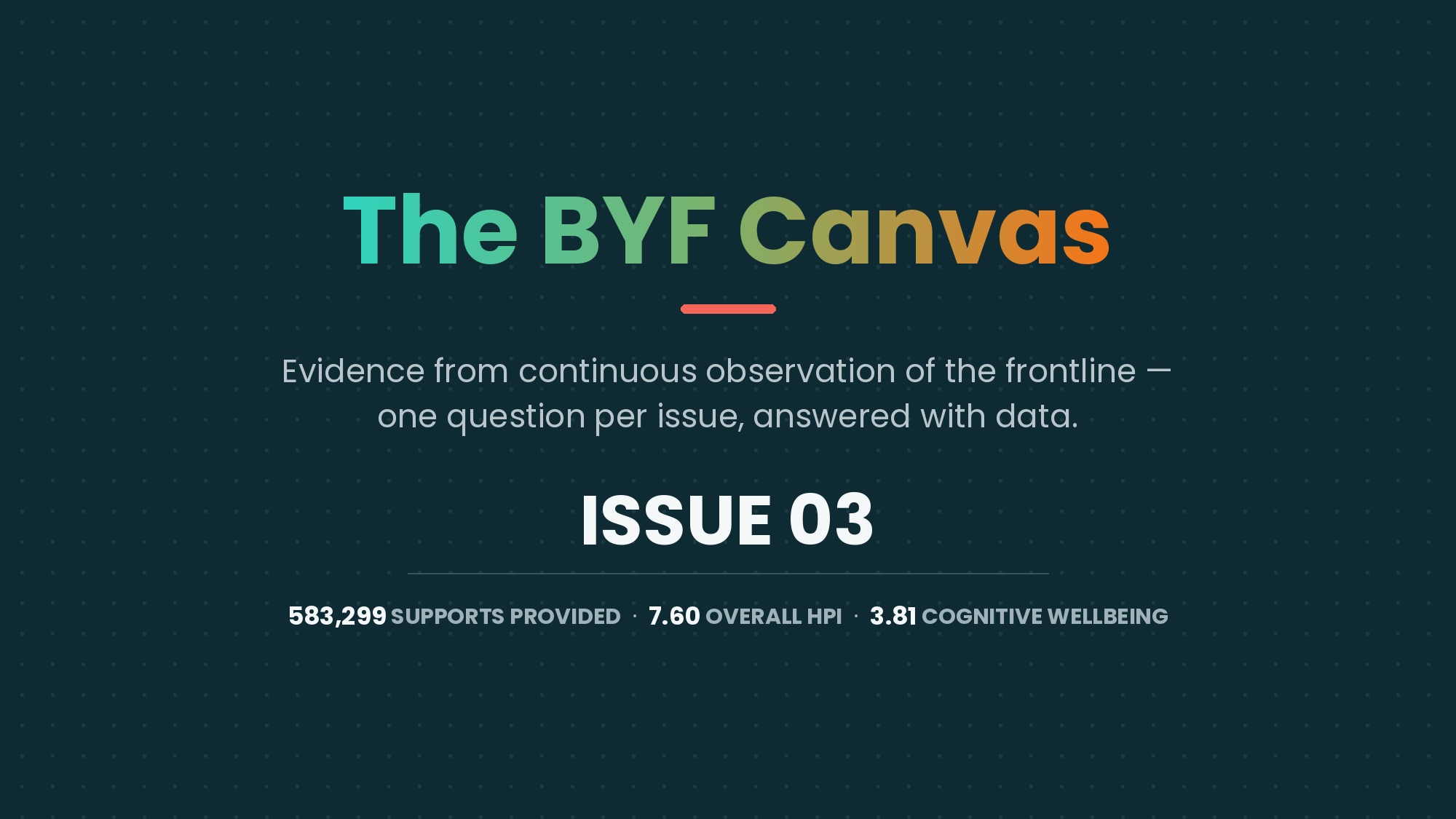
Overall HPI : 7.60 / 10 (Thriving) – This is a cumulative of initial assessments, follow on check-ins and risk mitigation interventions consumed by the data population.

Looking closer at the JD-R output:


What mattered are the Interventions consumed through a one year journey (direct on app / indirect through management recommendations) that moved the HPI needle

“Health & Wellbeing is NOT just absence of illness. Access to such an infrastructure goes beyond the typical 2-4% usage of emergency support, and more importantly covers a larger set of work force that requires supportive interventions that develop resilience reserves”
When we compare and overlay the demographic Burnout index (covered in Issue 2) with the Assessed HPIs, it observed a direct correlation between the two: For eg: a cohort of Burnout index being 7.04, had the corresponding avg HPI of 7.39.
The Medical Risk Index: Reading into the medical health markers & conditions from PEME to assess impact on Performance and how reliability can be further amplified with it…
bigyellowfish is purpose-built for the maritime frontline. Its three pillars are not separate wellness tools — they are a unified human reliability platform engineered in behavioural science, gamified for sustained engagement, and designed to generate auditable evidence for leadership and insurers. (Holistic Health & Wellbeing + Communication + Social)
The insights and findings in this Knowledge Series are based on empirical data available on BigYellowFish (“BYF”) platform available to BYF at the time of publication. They are generic and informative in nature, they should not be interpreted as representative of the entire maritime industry or as a prediction, or determination of any individual or organisation.
The metrics, indices, methodologies, and observations may evolve as additional data becomes available. Unless expressly stated otherwise, all statistics and observations should be read in the context of the relevant methodology, population and period. The information is not a substitute for professional advice, and readers should undertake their own assessment before relying on it. Nothing in this publication or any engagement with BYF creates a therapeutic or advisory relationship. Any extrapolation beyond such context is undertaken at the reader's discretion and risk and BYF shall not be liable in any manner whatsoever.
Leave a Reply